
Why it Pays to Communicate

This article was written by Freya Robbins
You may be asking yourself why you should even try anymore to make it work with this relationship. You believe that you have earnestly put in the time and effort, you have recommended and or tried counseling, and talking to your spouse but regardless of the methods and attempts you have made, your relationship is teetering on the fine line of being over. We can all agree that we have been at this place before and I assure you that you are not alone! You are not wrong, and you are not crazy.
Communication requires both people engaged in the conversation and being willing to be open to:
- Listening
- Hearing what the other person is saying and feeling
- Understanding
- Compromise
In this blog we will be sharing several strategies that can help you communicate with your loved ones.
So how do you get yourself and your spouse to a healthy place to communicate effectively with one another? First of all- how do you like to communicate? Is it easier to write things down before having a discussion to organize your thoughts? Do you like to approach things as they come up? Or are you a planner and want to know answers to potential scenarios before they ever come up? There are different communication styles, and it is important to understand your communication style and your partner’s communication style. If they are different, there could be a disconnect that you’re not aware of. When you have a good understanding of how you communicate and how your partner does, then you can effectively communicate with them.

We frequently work using the DISC model which helps individuals, and couples assess both their communication style as well as the person they want to communicate with. If you are communicating with a bottom-line person, they don’t want to hear how the watch was built, they just want to know what time it is. You get my drift I am sure but knowing and understanding the language of the persona you are dealing with is very important.
An important component of communicating is active listening and really hearing what your loved one is saying. A good practice to get into is to listen to what your partner is saying and not focus on what you want to respond with while they are taking. Focus on what they are saying and feeling. When your partner has finished saying what they need to say, repeat back to them in your words what you heard them say with the emotion that they shared with you. Then ask if you heard them correctly. For example, “What I heard you say is that you are feeling overwhelmed, is that correct?” That allows the other person the chance to re-articulate what they were trying to convey if that wasn’t what they wanted to convey and lets them know that you were really listening and engaged to what they had to say; this holds a lot of value for relationship building. We all want to be heard and we are disappointed when we don’t feel important enough to be recognized and truly listened to.
Once both people have had the chance to share and feel heard, it can create a safe space and an opportunity for future growth in that relationship. Even if the views are different, you have created a space that allows for the conversation to happen and for future positive conversations too. Another good practice when talking with your spouse is to ask, “Is this a:
- Listen
- Talk, or
- Fix It, conversation?
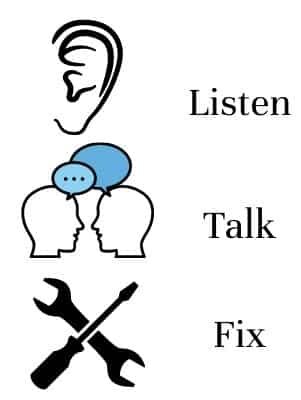
One common complaint I hear typically from women is, “He doesn’t listen to me, he just wants to fix it.” This is not unusual because the majority of men think they are supposed to solve the problem. If you think about it, men have been socialized to be providers and fixers of problems. Women typically want to be heard, but sometimes they want it to be fixed too.
The point here is to communicate what you want your mate to do. Do you want them to just listen, do you want to talk or banter back and forth about it or do you want them to fix it for you? Communication starts with you and you will help everyone by sharing what your expectations are.